
There are 3 fundamental questions you should be able to answer, if you want to sell your solutions.
- Why would a potential client buy anything at all?
- Why would they buy from us?
- And why now?
Value propositions hold the answer to question #2 – Why would a client buy from us?
Strategyzer, famous for their Value Proposition Canvas, defines a value proposition as…
“[…] a statement that clearly outlines the unique benefits and value a company offers to its customers. It answers why a customer should choose your product or service over others.”
At Strategyzer they talk about customers. Obviously, in professional services, there are no customers. You’re selling to organizations. We’ll refer to them as clients.
Now, at these clients, the decision to buy from you is made by a group of people: the decision making unit (or DMU).
This makes business to business (B2B) marketing and sales different from business to consumer (B2C) marketing and sales.
However, Strategyzer’s definition and Value Proposition Canvas are still valid in professional services.
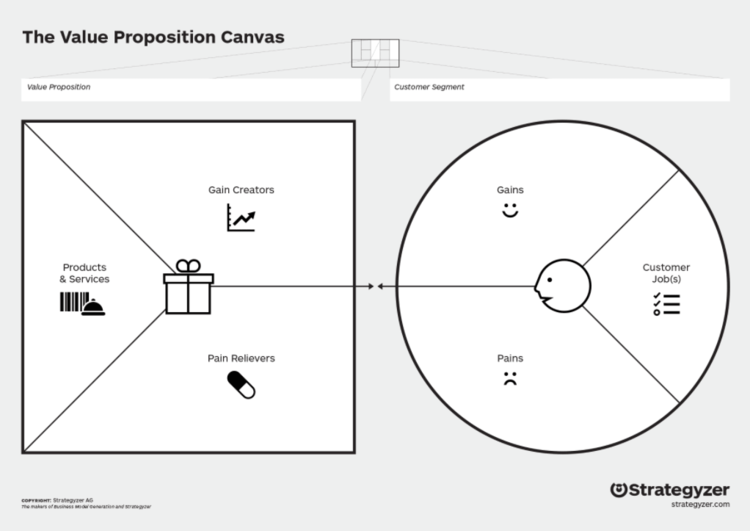
According to Strategyzer, you should start on the right hand side of the canvas.
You’ll first observe a client segment.
- Organizations execute certain tasks (= jobs).
- They do so, because they expect results or benefits (= gains).
- While, before, and after they execute these tasks, they experience frustrations, risks, and disadvantages (= pains).
Once you’ve mapped all jobs, gains, and pains, you can go ahead and design your solution.
- List products & services.
- How these help clients achieve the results or benefits they’re after (= gain creators).
- And how these help clients overcome certain pains (= pain relievers).
A great exercise! However, in most professional services firms, you don’t have the luxury to “design a new solution”. Also, client segments aren’t always well defined.
So, how should you use the Value Proposition Canvas in professional services?
I like to start on the left hand side; the side that’s all about you and your solution.
- Break down a solution into comprehensible steps or phases.
- List the unique benefits of your solution.
Switch to the right; the client side.
- For your most profitable client segment, list their jobs. Stick to an organizational level*. And don’t worry too much about breaking down open doors.
- List the gains they’re after.
- List the pains they experience.
* It could be useful to list the jobs of people actually using your solution. However, you probably won’t sell your solution to them. It may be more important to understand what initiators and decision makers from the DMU are after.
Once you’re done, go back to the left side.
- List your pain relievers. What specific value do you bring that the competition doesn’t?
Keep going back and forward until you’ve realized a ‘fit’ in which your pain relievers and gain creators can be linked to a client’s pains and gains.
Once you’ve developed value propositions on a solution level, you could move on to an industry level (in order to target a specific client segment) or a more holistic organizational level (to determine the value your company brings).
Hope this helps!
Thank you for reading MBD Spark #104, sent on March 24, 2026.
Are you an MBD Spark subscriber?

Bi-weekly tips & thoughts on marketing & business development.
For everyone involved or interested in bringing professional services to market.
Subscribe today!